Introduction
Have you noticed how fast the world moves? Everything happens so quickly: screens, instant messages, noise, rushing… We live in an age when it is hard to find moments to stop, think and listen to ourselves.
In the middle of this hectic pace, chess is different. When you sit down at a board, it is like pressing a pause button. Time seems to slow down. There is no need to rush or do anything in a hurry. What matters is to look, analyse and decide.
This pause is not doing nothing. On the contrary: the brain works hard. Chess makes you think, remember, imagine and control your impulses. That is why it can be seen as a kind of mental gymnastics. Several studies have pointed out that learning chess can help train skills such as concentration and problem-solving (Gobet & Campitelli, 2006).
Many teachers and families have seen this in practice. Very restless children manage to stay focused for longer. Others gain confidence because they discover they can find solutions on their own. It is not only about winning or losing, but about learning to think.
In an age full of immediate stimuli, chess —especially in competition— asks for something unusual: keeping your attention for a long time. A game can last between two and four hours, and you have to stay focused the whole time. This kind of deep attention resembles what the psychologist Mihaly Csikszentmihalyi called the state of flow, that moment when you are so absorbed in a task that time seems to disappear (Csikszentmihalyi, 1990).
Chess also has a very special feature: it lets people of different ages relate to one another on equal terms. In a tournament, a child can play against an adult or an older person. At the board, everyone has the same pieces and the same rules. This encourages respect, coexistence and shared learning.
Another important aspect is that, in official competition, you have to record the moves. This is not just writing. It is useful for reviewing the game afterwards, seeing what worked, what did not and how it can be improved. It is a process similar to the scientific method: observe, analyse and correct.
This way of understanding chess is the basis of many educational approaches. It is not just about playing, but about creating situations in which the game helps train thinking. When children solve challenges, discuss moves and reflect on their mistakes, they are working on attention, working memory, planning and self-regulation (Pérez, 2026).
That is why, when we talk about chess, we are not just talking about a game. We are talking about an experience that helps you think calmly, try out solutions and accept that making mistakes is part of learning. Every move is a decision, and every decision has consequences. This teaches responsibility and perseverance.
Little by little, many children carry this way of thinking into other moments of life: they organise themselves better, they try harder in the face of difficulties, and they learn not to settle for the first idea but to look for a better one. Some research suggests that the skills trained through chess can transfer to the academic and cognitive fields (Sala & Gobet, 2016).
What matters most is not delivering a quick checkmate. The true value of chess is learning to stop, think and decide with purpose. With a small board, children can build bigger, calmer and deeper thinking in a world that almost never stops.
Part I: Competitive chess
When we think about doing sport, we often imagine running, jumping or kicking a ball. But chess is also a sport. The difference is that here you do not train your arms or legs, but your brain. Instead of physical strength, you need concentration, mental stamina and the ability to think before acting.
Chess also has a universal language. If you travel to any country in the world, you may not understand the language, but you will be able to play a game. The rules are the same everywhere, and that makes it a shared activity across different cultures (UNESCO, 2012).
Just as an athlete trains every day, a chess player must do so too. Research on expert learning shows that improving in any discipline requires deliberate practice, that is, training with intention, effort and review of mistakes (Ericsson et al., 1993). In a long game, the player has to remember ideas, calculate variations and keep their attention for a long time. It is like taking the mind to the gym.
In chess there is almost no chance. If you lose, it is usually because some decision was not the best. This, although it may seem demanding, has great educational value. The psychologist Carol Dweck explains that situations like these foster a growth mindset, the idea that abilities can be developed through effort and learning (Dweck, 2006). The mistake stops being a failure and becomes an opportunity to improve.
Competition also teaches you to manage your nerves. At the board, your heart races and the urge to move appears. But the rules force you to control that impulse. The "touch-move" rule means the player has to think before acting. This self-control is a skill that can later help in exams, conflicts or everyday decisions. Longitudinal studies have shown that the development of self-control in childhood is linked to positive outcomes throughout life (Moffitt et al., 2011).
In chess you learn a very clear lesson: sometimes you win and sometimes you learn. FIDE, as the international organisation that promotes chess around the world, stresses that the educational goal is not only to train champions, but to help form people capable of thinking better and making responsible decisions (FIDE, 2024). The chess journalist Leontxo García has underlined that competitive chess teaches emotional management, tolerance to pressure and strategic planning, skills that go beyond the board (García, 2022).
In addition, Magnus Carlsen, world champion, has explained in interviews that top-level practice demands not only calculation and memory, but mental stamina, self-control and the ability to hold concentration for hours, recalling that consistency and patience are key both in chess and in other aspects of life (Carlsen, 2024).
All this has a direct impact on personal development. When someone solves a complicated position or sees that they improve with practice, their confidence grows. They learn that making progress takes time, patience and effort. Analysing games, reviewing mistakes and trying new ideas becomes a work habit that can also be applied to studying and other challenges.
Educational research has observed that chess practice can help train cognitive skills such as concentration and problem-solving (Gobet & Campitelli, 2006). That is why we say that competing in chess is not just playing: it is learning to think rigorously, to control oneself and to persevere.
Part II: Chess as a game-based educational resource
Educational chess goes far beyond the simple game. It is not only about winning games or memorising moves; its real value lies in learning to think, to solve problems and to make decisions consciously (Pérez, 2026). When students come into the classroom, a safe space is created where they can make mistakes without fear, thanks to the immediate feedback the game offers: if a plan fails, the opponent's reply shows the mistake at once, which lets them adjust their thinking and learn actively (Pérez, 2026). This experience fosters curiosity, creativity and confidence, and helps students understand that the process of thinking is more valuable than always being right.
According to Jerry Nash, chair of FIDE's Chess in Education Commission and a consultant for the Chess in Schools and Chess in Education foundation in the United States, chess can be much more than a game: it is a way of practising good decisions and thinking well (Nash, 2015). From his experience as an educator, students who play chess tend to show greater concentration and engagement with school activities, and can develop important skills such as decision-making, problem-solving and teamwork. Nash points out that teachers can use chess in the classroom to reinforce academic competencies and 21st-century skills without adding to their daily workload, creating a positive environment that motivates students to think and learn actively (Nash, 2015).
As Jesper Hall (2021) explains: "Chess can support children who struggle with thinking," because the game allows all children, not only the most skilful, to develop cognitive skills, strategies and confidence in a safe and stimulating environment. This is what distinguishes chess in education from traditional talent training: here it does not matter whether children become good players, but how the game helps them grow intellectually and socially.
During the game, chess sets in motion concentration, imagination, the ability to plan moves and pattern recognition (chunking). Students learn to organise information into meaningful structures: where a beginner sees scattered pieces, a trained student detects "a pawn chain" or "an attack on the King" (Pérez, 2026). This ability to simplify complexity is transferable to reading, where we group letters into words; to mathematics, where we structure data and steps to solve problems; and even to artistic projects, where planning a composition requires anticipating decisions.
Chess can also have a compensatory effect: students with academic difficulties can improve their logical reasoning, especially in mathematics, thanks to its visual and hands-on component, which breaks down the barriers of numerical abstraction (Rosholm et al., 2017).
The most relevant educational benefit is metacognition. Playing forces you to keep a constant inner dialogue: "If I do this, they will do that, then I will be able to…", training the habit of thinking about your own thinking and activating the prefrontal cortex (Costa & Kallick, 2009). When students explain their moves, they practise argumentation, critical reasoning and the capacity to reflect, reinforcing the transfer of learning to other academic areas and to everyday life.
Moreover, chess educates emotionally: learning to win with respect, lose without frustration and wait your turn develops patience, tolerance and social skills (Kazemi et al., 2012). This inclusiveness, where each student can progress at their own pace and learn from mistakes, makes chess a powerful resource for fostering autonomy and confidence.
In short, with a clear methodological approach and educational intent, chess stops being just a game: it becomes a cross-curricular resource that integrates academic content, cognitive skills, social-emotional competencies and creativity, favouring holistic, deep and meaningful learning.
Part III: Chess beyond the board: cross-curricular learning
You may think that chess and school are completely different things, but that is not the case. Chess helps train the mind and develop skills such as concentrating, getting organised and thinking logically, skills that then help you cope better with school and many life situations (Pérez, 2026). When you play, you are doing maths without realising it: you count squares, calculate values, foresee moves. You are practising language when you explain your plan to a classmate or argue why you moved that piece. And you also train emotions and values: you learn to be patient, to control your nerves, to wait your turn and, above all, to respect the person in front of you. These are small lessons that later carry over to the classroom, the playground and home.
Chess makes you feel like a little captain of your own adventure. Every move is a decision you have to take on. If you move a piece, you cannot take it back; you have to accept the consequences, good or bad (Pérez, 2026). This helps us think globally: to look at the whole board, prepare a strategy and foresee problems before they appear. It is like directing your own film, where you decide every scene and learn to face situations before they get complicated.
But the most interesting thing is that everything you learn in the game does not stay there. When it ends, you take everything you have discovered with you in your backpack of knowledge. International research confirms it: the concentration, planning and problem-solving skills you train with chess carry over into real life (European Parliament, 2012). Many teachers and educators have seen that students who play regularly improve in other subjects, remember what they study better and learn to organise themselves. They also learn to respect others, to cooperate and to face difficult situations without giving up.
Chess is not just a game of pieces on a board. It is an educational tool that unites mind, emotion and behaviour. With every game, you learn to think in a structured way, to manage your emotions and to weigh up your own decisions and those of others. This gives children confidence and autonomy: they learn that they can be responsible and creative, that they can prepare a plan and adapt when things do not go as expected. It is learning that lasts far beyond the classroom, because it helps to organise everyday life and to relate better to classmates and friends.
With chess, every game is an opportunity to grow, not only intellectually but also emotionally. Students train their patience, learn to think before acting, to face frustration and to celebrate effort, not just the result. All of this makes chess much more than a game: it is a resource that connects school, emotions and life skills.
Chess makes it possible to work in a cross-curricular way: it develops mathematical competencies (calculation, estimation, problem-solving), linguistic ones (arguing moves, explaining strategies, active listening), personal and social ones (respect, emotional management, cooperation) and learning to learn. This cross-curricular nature is especially powerful because it starts from real situations: every game requires anticipating, making decisions, taking on consequences and adapting to change, exactly the same skills needed later to tackle a school task, group work or an everyday conflict.
According to Marta Amigó, a Catalan reference in educational chess and coordinator of the "Chess at School" programme, chess not only helps with learning the game, but is also used as an educational tool within school hours to work on aspects such as mental arithmetic, reading comprehension, decision-making, problem-solving and social skills like respect and patience, making it possible for chess to connect different areas of the school curriculum and contribute to students' holistic development (Amigó, n.d.).
For Fernández Amigo (2016), chess can act as a tool for curricular integration, since it makes it possible to design activities that connect several areas of knowledge within a single educational context. In this way, the game can link competencies in a natural and meaningful manner:
- Language: Arguing moves and explaining strategies helps develop linguistic competence, the ability to narrate and the use of verbal reasoning.
- Mathematics: Analysing the value of the pieces, calculating sequences and planning moves reinforces problem-solving, logical thinking and the capacity for abstract reasoning.
- Art and creativity: Representing tactics in visual schemes or designing graphic strategies stimulates creativity, imagination and spatial planning.
- Social sciences and values: Chess encourages reflection on the ethics of the game, respect for classmates, emotional management and responsible decision-making.
In this way, chess becomes a cross-curricular resource that not only works on specific content, but also integrates cognitive, social-emotional and creative skills within the classroom (Fernández Amigo, 2016).
Along these lines, the work of Marc Pera Muntasell offers a particularly relevant perspective on the tutorial and emotional dimension of chess at school. In his undergraduate study at the Autonomous University of Barcelona, he argues that chess can become a cross-curricular pedagogical tool when it is intentionally integrated into tutorial action and emotional education. Beyond competition or technical performance, he proposes the game as a space for working on self-regulation, decision-making, error management and metacognitive reflection, thus connecting the board with key developmental processes in the primary-school stage (Pera, 2023).
One of the most powerful psychological concepts that chess works on is the Internal Locus of Control. Low-achieving students often believe that things "happen to them" (external locus: bad luck, "the teacher has it in for me"). Chess teaches the opposite: you are responsible for your own position. If your king is in danger, it is a consequence of your previous decisions. Understanding that one is an agent of one's own destiny is one of the strongest predictors of future academic and professional success (Rotter, 1966).
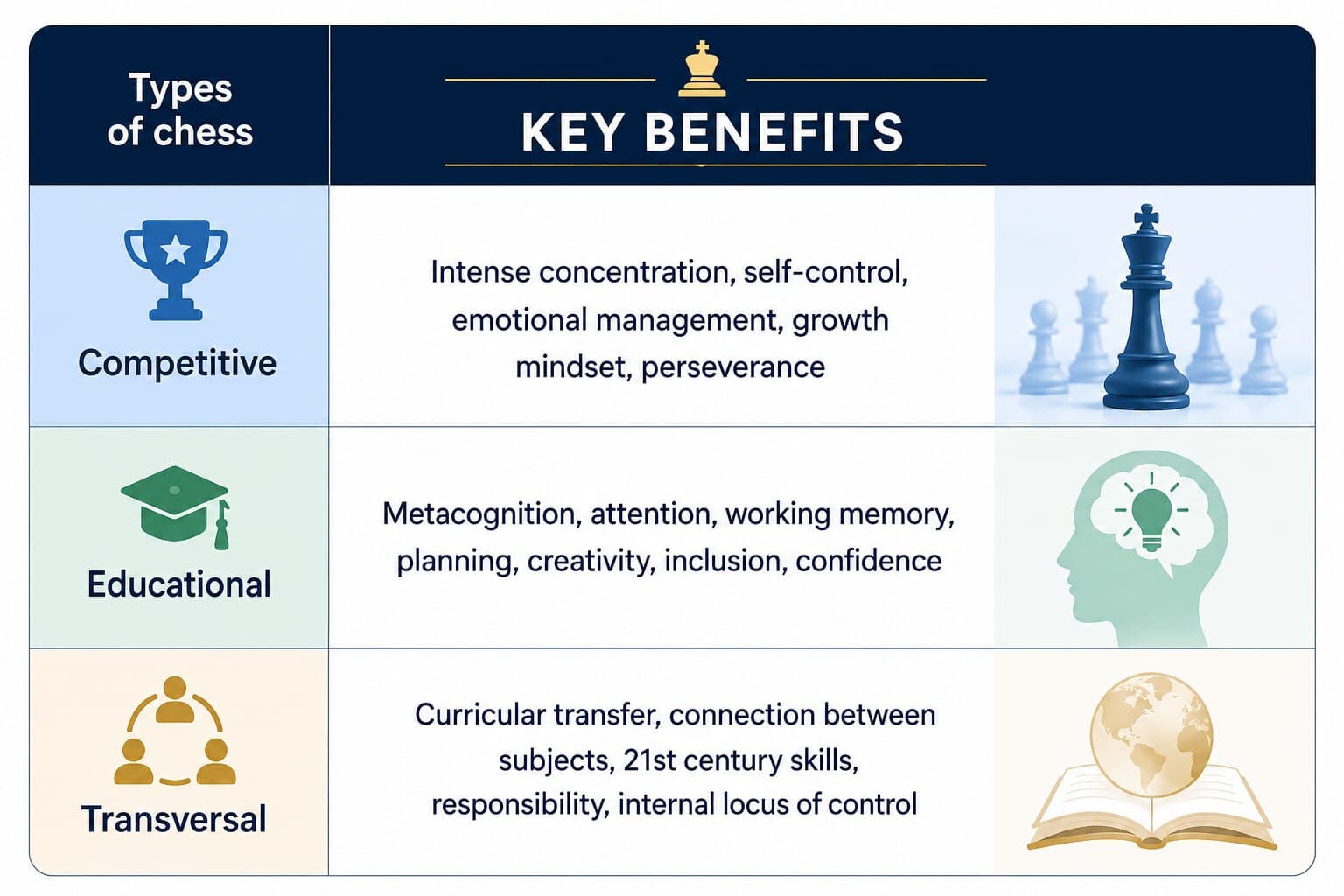
Comparison and synthesis of the types of chess and their benefits
Chess can offer different benefits depending on the approach to practice. Competitive activities seem to stimulate concentration, self-control and perseverance, although these effects depend on the intensity and duration of training (Gobet & Campitelli, 2006; Moffitt et al., 2011). Educational chess, focused on learning within the classroom, can foster cognitive skills such as attention, working memory and planning, as well as social-emotional aspects such as inclusion and confidence (Costa & Kallick, 2009). Cross-curricular practice, which integrates chess with other subjects and competencies, can help apply problem-solving and critical thinking in school contexts, although the transfer to other areas still needs more empirical evidence (Fernández Amigo, 2016; Sala & Gobet, 2016).
Appendix
Chess is so special that it does not stay locked in your classroom or the neighbourhood community centre; it travels all over the world. There are very important international organisations that study and protect it, and I will tell you about them as if they were little guardians of the game.
First let's talk about UNESCO, which is like a great guardian of education around the world. Imagine a huge organisation that works so that all children can have a quality school. Even though they do not teach chess lessons, they really like this game because it fits with what they defend: learning to think, to understand things and to find solutions, not just to memorise moves. They also value that chess teaches you to play fair, to respect others and to get along well with teammates and rivals, skills that are not only useful in the classroom, but will stay with you for the rest of your life (UNESCO, 2012).
Then we have the "captains" of the game: FIDE, the International Chess Federation. If football has FIFA, chess has FIDE. They are the ones who lead and organise the game around the world, but they do not only put on championships for grandmasters. They have a very special mission: to bring chess to schools, making this mental sport reach every child, wherever they live. Their idea is for the game to awaken thinking, creativity and decision-making in all children (FIDE, 2015).
Finally, there are those we might call the "brain detectives": scientists and researchers from universities all over the world who have spent years looking closely at what happens inside our heads when we play chess. And what have they discovered? That memory grows stronger, that concentration improves and that you learn to solve problems without getting so nervous. But there is a very important secret these researchers have found: chess works much better when you enjoy it. If you play without pressure and with a desire to learn, your brain makes far more of all the training, and that is exactly what makes every game an opportunity to grow (Gobet & Campitelli, 2006).
Chess, then, is not just a game of board and pieces. It is a journey that connects the classroom with the world, a resource that combines learning, emotion and fun, and that teaches you to think, to decide and to grow as a person.
References
Aciego, R., García, L., & Betancort, M. (2012). The benefits of chess. International Journal of Developmental and Educational Psychology, 1(1), 27–34. https://revistas.um.es/ijep/article/view/ijep1.1.2
Amigó, M. (n.d.). On the educational and cross-curricular value of chess. In the context of the Chess at School programme of the Catalan Chess Federation. https://diarieducacio.cat/escacs-educatius-tot-el-que-no-explica-gambito-de-dama/
Anand, V. (2015). Chess and the art of thinking: Lessons from the game. ChessBase Articles. https://en.chessbase.com/articles
Bart, W. M. (2014). On the effect of chess training on scholastic achievement. Frontiers in Psychology, 5, 762. https://doi.org/10.3389/fpsyg.2014.00762
Carlsen, M. (2024). Magnus Carlsen on the mental demands of elite chess: pressure, focus, burnout and balance. [Video]. YouTube. https://www.youtube.com/watch?v=nA7iSB6bBfY
Costa, A. L., & Kallick, B. (2009). Learning and leading with habits of mind: 16 essential characteristics for success. ASCD. https://www.ascd.org/books/learning-and-leading-with-habits-of-mind
Csikszentmihalyi, M. (1990). Flow: The psychology of optimal experience. Harper & Row.
Diamond, A. (2013). Executive functions. Annual Review of Psychology, 64, 135–168. https://doi.org/10.1146/annurev-psych-113011-143750
Dweck, C. S. (2006). Mindset: The new psychology of success. Random House.
Ericsson, K. A., Krampe, R. T., & Tesch-Römer, C. (1993). The role of deliberate practice in the acquisition of expert performance. Psychological Review, 100(3), 363–406. https://doi.org/10.1037/0033-295X.100.3.363
European Parliament. (2012). Declaration on the introduction of chess in schools. https://www.europarl.europa.eu/doceo/document/TA-7-2012-0270_EN.html
Fernández Amigo, J., & Prió Burgués, J. (2016). Las transversalidades del ajedrez. Balagium Editors. https://www.balagium.com/es/producto/las-transversalidades-del-ajedrez/
Fédération Internationale des Échecs. (2015). Chess in Education. FIDE. https://www.fide.com
Fédération Internationale des Échecs. (2024). Chess in Education. FIDE. https://www.fide.com
FIDE. (n.d.). Chess as a sport and educational tool. https://www.fide.com/FIDE/handbook/chess-in-education
García, L. (2022). Leontxo García: escacs i pensament, emocions i valors. El Crític. https://www.elcritic.cat/entrevistes/leontxo-garcia-la-millor-manera-dexplicar-la-guerra-freda-es-parlant-descacs-130780
García, L. (2024). ¿Para qué sirve el ajedrez en educación? BBVA Aprendemos Juntos. https://aprendemosjuntos.bbva.com/ca/especial/para-que-sirve-el-ajedrez-en-educacion
Gobet, F., & Campitelli, G. (2006). Educational benefits of chess instruction: A critical review. Cognitive Processing, 7(2), 95–104. https://www.researchgate.net/publication/236883992_Educational_benefits_of_chess_instruction_A_critical_review
Hall, J. (2021, October 9). Chess: a way to support children who struggle with thinking! Educational Chess Summit.
Kazemi, F., Yektayar, M., & Abad, A. M. B. (2012). Investigation of the impact of chess play on developing metacognitive ability and math problem-solving skill. Procedia – Social and Behavioral Sciences, 32, 372–379. https://doi.org/10.1016/j.sbspro.2012.01.056
Moffitt, T. E., Arseneault, L., Belsky, D., Dickson, N., Hancox, R. J., Harrington, H., … & Caspi, A. (2011). A gradient of childhood self-control predicts health, wealth, and public safety. Proceedings of the National Academy of Sciences, 108(7), 2693–2698. https://www.pnas.org/doi/10.1073/pnas.1010076108
Nash, J. (2015). University of Texas at Dallas Chess Program — Chess Educator of the Year. UT Dallas. https://chess.utdallas.edu/education-programs/chess-educator-of-the-year/
Pera Muntasell, M. (2023). Estratègies d'acció tutorial a través de l'educació emocional i els escacs a l'aula de primària [Undergraduate dissertation, Universitat de Girona]. https://www.udg.edu/ca/Portals/68/OContent_Docs/TFG_Marc_Pera_ESTRATEGIES_D_ACCIO_TUTORIAL_A_TRAVES_DE_L_EDUCACIO_EMOCIONAL_i_ELS__ESCACS_A_L_AULA_DE_PRIMARIA.pdf
Pérez Rodríguez, R. (2026). Jugar a escacs, on no parlar està prohibit. Xerpa Edicions.
Reizniece, D. (2015). Chess in education: Forming better thinkers, not just champions. FIDE Interviews. https://www.fide.com/news/417
Rosholm, M., Mikkelsen, M. B., & Gumede, K. (2017). Your move: The effect of chess on mathematics test scores. PLoS ONE, 12(2), e0170520. https://doi.org/10.1371/journal.pone.0170520
Rotter, J. B. (1966). Generalized expectancies for internal versus external control of reinforcement. Psychological Monographs: General and Applied, 80(1), 1–28. https://doi.org/10.1037/h0092976
Sala, G., & Gobet, F. (2016). Do the benefits of chess instruction transfer to academic and cognitive skills? A meta-analysis. Educational Research Review, 18, 46–57. https://doi.org/10.1016/j.edurev.2016.02.002
Trinchero, R., & Sala, G. (2016). Chess training and mathematical problem-solving. European Journal of Educational Psychology, 9(2), 69–84. https://doi.org/10.1080/21683603.2016.1189136
UNESCO. (2012). World sport values and education. https://unesdoc.unesco.org/ark:/48223/pf0000219551